Download Wiring Your Model Railroad (Essentials)
Wiring Your Model Railroad (Essentials). Offer us 5 mins and we will reveal you the very best book to read today. This is it, the Wiring Your Model Railroad (Essentials) that will certainly be your finest choice for much better reading book. Your 5 times will certainly not spend wasted by reading this website. You could take the book as a resource to make better concept. Referring the books Wiring Your Model Railroad (Essentials) that can be situated with your needs is sometime difficult. Yet below, this is so easy. You could discover the most effective thing of book Wiring Your Model Railroad (Essentials) that you could review.
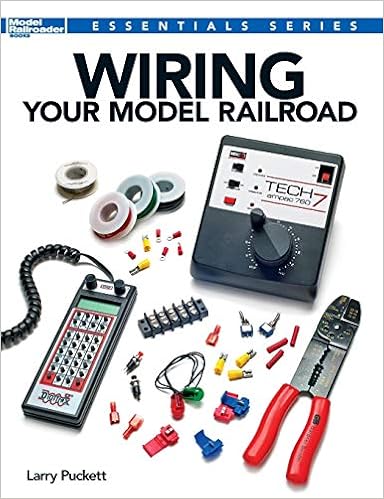
Wiring Your Model Railroad (Essentials)

Download Wiring Your Model Railroad (Essentials)
Come join us to discover your favorite publication. If you really feel difficult and also confused to get the book currently, you can try Wiring Your Model Railroad (Essentials) Thanks for visiting this brand-new coming book, please. Yeah, why we additionally provide you to read this publication is likewise affected by some variables. The elements are definitely recommended for reading this book. When you have visited this internet site, you can locate such link and reach click it currently.
Several duties in this recent period require guide not just from the most recent book, but likewise from the old book collections. Why not? We serve you all collections from the earliest to the latest publications worldwide libraries. So, it is extremely finished. When you feel that guide that you have is really book that you want to check out currently, it's so pleasured. But, we truly suggest you to read Wiring Your Model Railroad (Essentials) for your own requirement.
So, should you review it quickly? Certainly, yes! Must you read this Wiring Your Model Railroad (Essentials) and finish it fast? Not! You could get the enjoyable reading when you are reading this book while taking pleasure in the extra time. Even you don't read the printed book as below, you can still hold your tablet and review it throughout. After obtaining the choice for you to obtain consisted of in this sort of models, you could take some methods to review.
Now, reading this spectacular Wiring Your Model Railroad (Essentials) will be easier unless you obtain download and install the soft file here. Simply below! By clicking the connect to download and install Wiring Your Model Railroad (Essentials), you could begin to obtain the book for your personal. Be the very first owner of this soft data book Wiring Your Model Railroad (Essentials) Make difference for the others and also get the initial to step forward for Wiring Your Model Railroad (Essentials) Here and now!
About the Author
Author Larry Puckett is a former columnist for Model Railroading magazine and has written numerous articles for Model Railroader and notable publications.
Read more
Product details
Series: Essentials
Paperback: 128 pages
Publisher: Kalmbach Publishing Company (August 1, 2015)
Language: English
ISBN-10: 1627001751
ISBN-13: 978-1627001755
Product Dimensions:
8 x 0.5 x 11 inches
Shipping Weight: 5.6 ounces (View shipping rates and policies)
Average Customer Review:
4.3 out of 5 stars
52 customer reviews
Amazon Best Sellers Rank:
#97,739 in Books (See Top 100 in Books)
I have Larry's other book and followed his articles in "Model Railroading", so I was looking forward to his new book.It's not a bad book, but not a great book either. It attempts to explain everything you would ever want to know about wiring in 128 pages - which is not possible. It covers both DC and DCC but not AC. Because it attempts to explain everything, some topics are covered lightly and in those area of the author's experience, in more detail. The author does a good job at the system level showing the equipment available and the interconnect between modules and the railroad. Herein, lies the books value. Integration of signaling systems is also illustrated. Track plans from previous issues of Model Railroader are used as examples.The book is aimed at the American HO gauge railroader, for example the author goes into detail about some HO turnouts, no N gauge turnouts are shown. Granted the concepts are the same for N gauge, but some examples would have been nice. Also, not all turnouts are illustrated; perusing the Walthers HO catalog, I found at least 4 brands that were ignored. Other than Peco turnouts, no other non-American equipment is shown. Likewise, with system components, no Bachmann or Hornby components. Only American suppliers are listed in the appendix. Missing from the illustrated turnout wiring diagrams are three way turnout and dual gauge turnouts.Figure 15 on page 93 can be confusing, showing 5 block occupancy detectors going to a single location. This happens when author grabs an existing piece or artwork and doesn't fully proof- I've been there and done that. (I constructively point these omissions out, so they can be added to the next addition.)Where the book falls short is on electrical theory. When discussing circuits, electron flow rather than current is shown. (Electron flow is in the opposite direction of current flow) While technically correct, current flow is the industry convention.The biggest failing is a lack of understanding of transmission line theory in the section on long power buses, pages 53ff. The description isn't quite correct. Figure 20 on page 54 shows an R-C network across the bus as a "filter". In this configuration, it has little if any effect, and doesn't protect the bus past this network. This is a common misunderstanding in model railroading. This mistake is understandable, as Richard Matrick says in his book, "....most professionals have little or no knowledge of transmission lines."(1)DCC signals move in time and space, consequently the voltage on the bus is not the same everywhere because the signal moves along the bus with a finite velocity. This is different than a DC bus where the voltage is the same all along the bus. When the rise (or fall) time of a signal is shorter than the travel time on the bus, transmission line effects must be considered. Thus, as the bus gets longer, the travel time increases giving rise to transmission line effects. (1) On model railroad buses, this length is about 30 feet (9 meters) when transmission line effects come into play.When the signal reaches the end of the bus (transmission line) if the bus is not terminated in the impedance of the bus, the signal will be reflected. This, added to the incident signal, 15 volts becomes 30 volts, enough to destroy a decoder. To suppress the reflected voltage, a resistor, typically 100 ohms is attached across the far END of the bus. This is called a termination load. Because a resistor sits across the bus, it will constantly dissipate power. To minimize the power, a capacitor is added in series, blocking DC voltage, and the terminator functions only when needed-on the rise and fall of the signal. Thus at first blush, it looks like a bus filter. The capacitor is a DC filter for the termination, not the bus. Calling the termination a filter or a snubber only confuses the issue and hides the actual function.In summary, a good overall systems book just be careful of some of the basic electrical theory.(1) "Transmission Lines for Digital and Communication Networks", Richard E. Matick, IEEE Press, 1995
Even though I have been doing modelrailroading off and on for 60 years and have built a layout for DCC and installed sound decoders, I found a lot of information in this book I didn't know. It should really have emphasized DCC in a subtitle. If you are not into DCC and this book doens't convince you then it has all you need to know about DC. I haven't bought other DCC books but I've read the author, Larry Puckett's, monthly column in Model Railroader. He also has a DCC website under the name DCCguy.com. He has many detailed subjects and it has been my go to place for information on things like keep alive current for DCC that is not found elsewhere. He invites responses to topics as well as new topics.But buy the book and get a terrific start in DCC or filling in the gaps in your knowledge
I give it 4 stars because I think Larry Puckett is very knowledgeable on the subject. However, I think this book is a lot of rehashed material from his previous book of a few years ago, and, while very informative, presents very little in the way of anything new or groundbreaking that wasn't in his previous book, which I thought was very good. Still, it's a good thing to have reference to when you need it, and I'm satisfied with the purchase overall.
Good overview of wiring for both the beginner and well-seasoned model railroader. Product description is accurate, so no need to repeat it here.
This was a pretty good book all in all but it is most definitely not for the rank beginner or a person without at least some background in basic electronics/electricity. So, not being that person, I was pretty overwhelmed which is not to say I didn't learn quite a bit. If you're just starting out in the hobby, consider looking for a more basic book.
Great book. I have four steam engines that I want to run at the same time plus the turn out controls and control panels information is just what I need. From what I've read so far, I recommend others to read this book.Rod
Not enough actual diagrams on layouts on blocks etc. . Far too complex descriptions. A beginner would just say “forget this†. No real explanations on advantages of DC vs DCL. Other than spending yourself into oblivion for a simple project for your kid. Definitely not for entry level.
Helpful but not what I expected. I will get some use out of it but my wiring is all traditional O-gauge. Book arrived fast and in good condition!
Wiring Your Model Railroad (Essentials) PDF
Wiring Your Model Railroad (Essentials) EPub
Wiring Your Model Railroad (Essentials) Doc
Wiring Your Model Railroad (Essentials) iBooks
Wiring Your Model Railroad (Essentials) rtf
Wiring Your Model Railroad (Essentials) Mobipocket
Wiring Your Model Railroad (Essentials) Kindle
0 komentar:
Posting Komentar